Field Notes From the Forest Floor
We’re delighted to welcome a familiar presence in a new way. For the past few years, he has contributed many photographs to Flora of Pennsylvania, images shaped by a lifelong habit of noticing the small, easily overlooked details of the natural world. Plants, insects, birds, wildlife: if it lives in the woods, he has likely paused to learn its name and capture its beauty. Now, his contributions extend from image to voice, offering a written glimpse into the same attentive, ground‑level perspective that defines his photography.
This edition turns our attention to the forest floor — the low, overlooked world beneath our steps. Here, fallen fronds, fading leaves, and the slow work of decay reveal patterns as intricate as any canopy above. These quiet processes, often missed in the rush of a walk, remind us how the forest renews itself through the smallest, humblest forms of life.
Treasures At Your Feet
Although often overlooked, ferns are some of the most widespread and durable plant species on our planet. In our modern world, ferns are one of the first species to emerge in an area after a disaster, whether it be a fire, volcanic eruption, flooding, or whatever else you can imagine that can have a major impact on the environment. They are able to do this due to the ease of dispersal of their extremely hardy spores and their very tough underground rhizomes. These features reach back well before our modern world when it comes to survival. Some fern lineages can be traced back to the Devonian period, over 400 million years ago. For comparison, the earliest record of flowering plants is from the early Cretaceous, about 130 million years ago. They have survived mass extinctions, glaciations, shifting continents, and a massive meteorite impact that wiped out the dinosaurs along with most of the other living organisms on the planet.
If you start with the ‘youngest’ known modern ferns it will be ferns in the adder’s tongue family or Ophioglossaceae. Species in this particular family do not fossilize well, so their history could reach back much farther, but spores and frond portions have been found dating back to the end of the Cretaceous period about 66 million years ago (the end of the dinosaurs). This family contains some of our most fascinating (and smallest) ferns which can be found in Pennsylvania. You can find the rattlesnake fern (Botrypus virginianus), moonworts (Botrychiums), grapeferns (Sceptridiums), and adder’s-tongues (Ophioglossum) species.
Ferns in the adder’s‑tongue family (Ophioglossaceae) are characterized by having a common stalk which divides into a sterile blade and a fertile sporophore bearing the sporangia. If you happen to come across one of these ferns with mature sporangia, just give it a little tap and you will see how easily the tiny spores can be distributed by even a gentle breeze. These small ferns can be found in a variety of habitats. I tend to find them in mixed deciduous and coniferous woodland, but they can also occur in more open and grassy areas.
Our most common species in the adder’s‑tongue family would be the rattlesnake fern (B. virginianus), which can be found in forests throughout Pennsylvania. It is also one of the earliest ferns to emerge, and its vivid green coloration is always a pleasant sight, seemingly hovering above the forest floor. It is a fairly small fern, growing up to about 50 cm tall, with a triangular blade usually around 10 cm across and 10 cm long.
When you are enjoying a walk in the forest, don’t forget to keep an eye on your feet. Not only to avoid stepping on delicate flowers and other living creatures of the forest, but also to notice some of the beautiful details in nature that are easy to overlook. Nature’s transition from life to death can be fascinating to watch and can be observed year‑round. This transition can be seen all around us as plants go dormant for a time or because their period of active growth has come to an end. I will focus on ferns and fallen leaves here, but all plants of the forest are well worth observing as they fade and decay. When combined with an understanding of what that decay provides to the health of the forest, the beauty becomes even more profound.
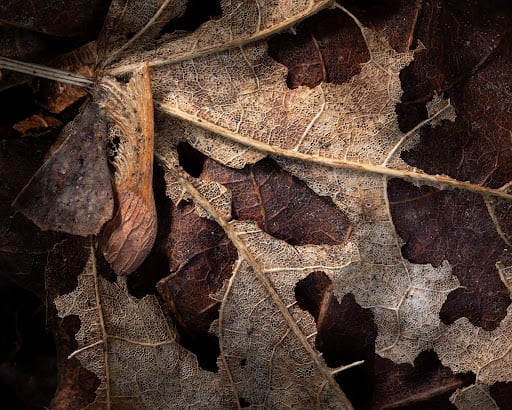
Sugar maple (Acer saccharum)
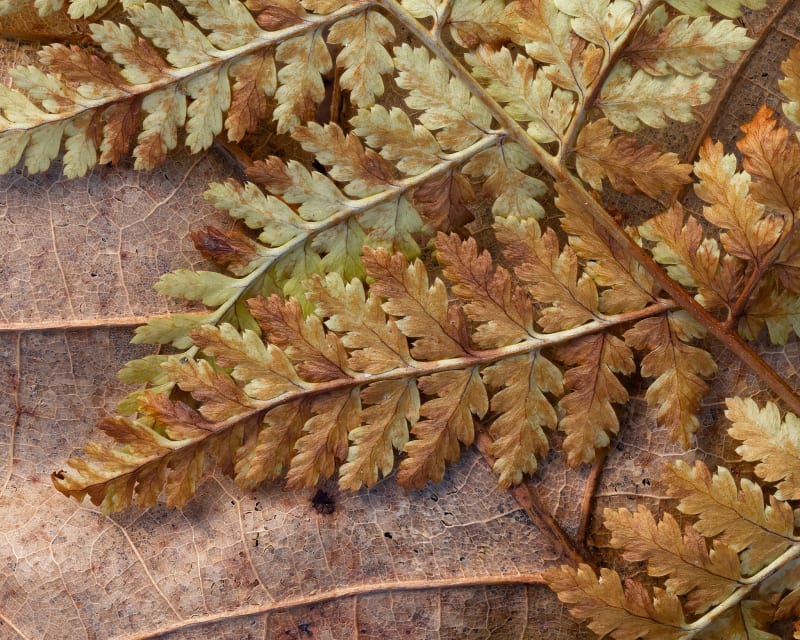
Intermidiate wood fern (Dryopteris intermedia)
Looking closely at the base of ferns and beneath the cover of lush green fronds can reveal an amazing world of browns with remarkable shapes waiting to be discovered. What were once the fronds nourishing the growing plant are now lying on the ground, either because they were damaged, or because they are what remains of previous years’ growth, yet their job is not done. They are now beginning the process of decay, a process that will continue to nourish the fern that they were once a living part of, along with countless other organisms, as part of the natural cycle of life, death, and decay. As they begin this process, some ferns, particularly members of the wood fern family (Dryopteridaceae), can go through beautiful color transitions and curling, twisting into amazing shapes and configurations. The intermediate wood fern (Dryopteris intermedia) is one of the most interesting to observe. Colors range from orange to almost golden and more, twisting and curling into ornate patterns at times. The marginal wood fern (Dryopteris marginalis) and the Christmas fern (Polystichum acrostichoides) will often turn an amazing dark chestnut brown and can beautifully contrast with fallen leaves on the forest floor. All three of these wood fern species are prevalent in Pennsylvania forests, and these and other fern species are certainly worth seeking out.
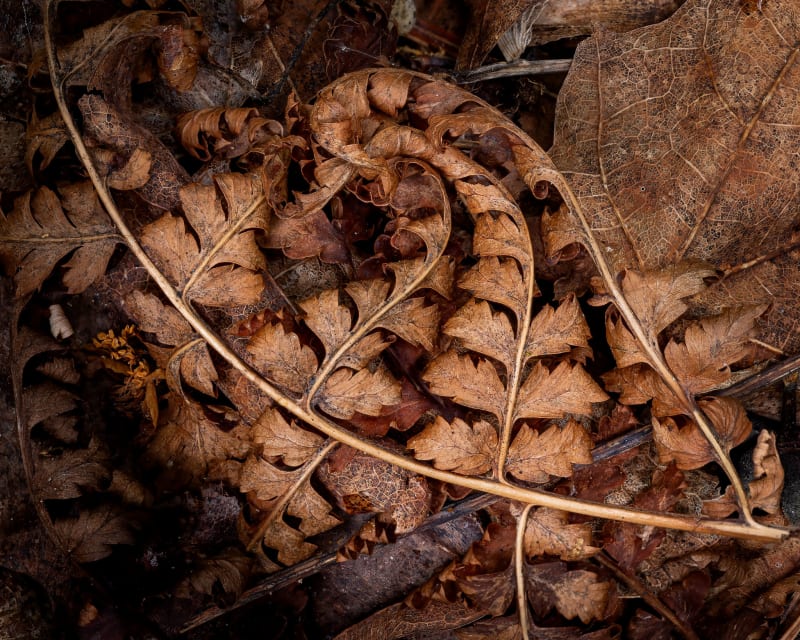
Intermidiate wood fern (Dryopteris intermedia)
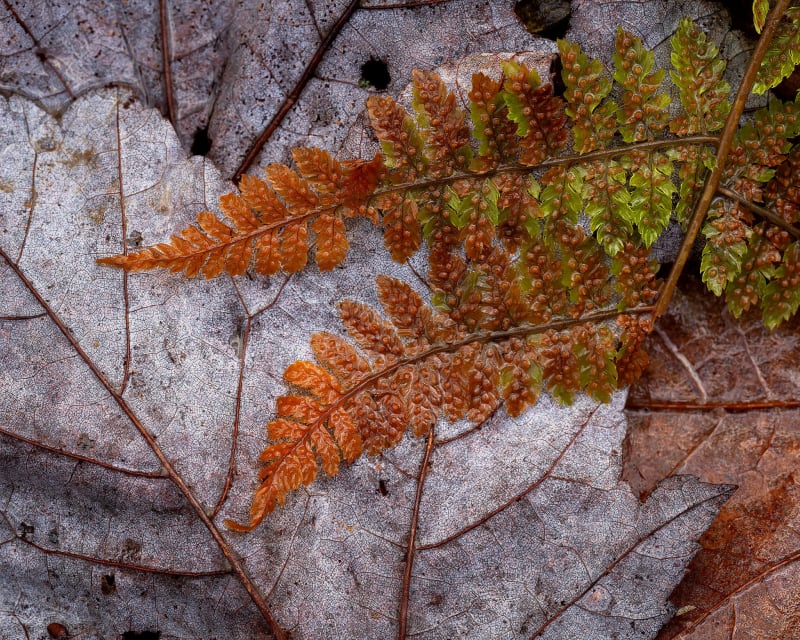
Intermidiate wood fern (Dryopteris intermedia)
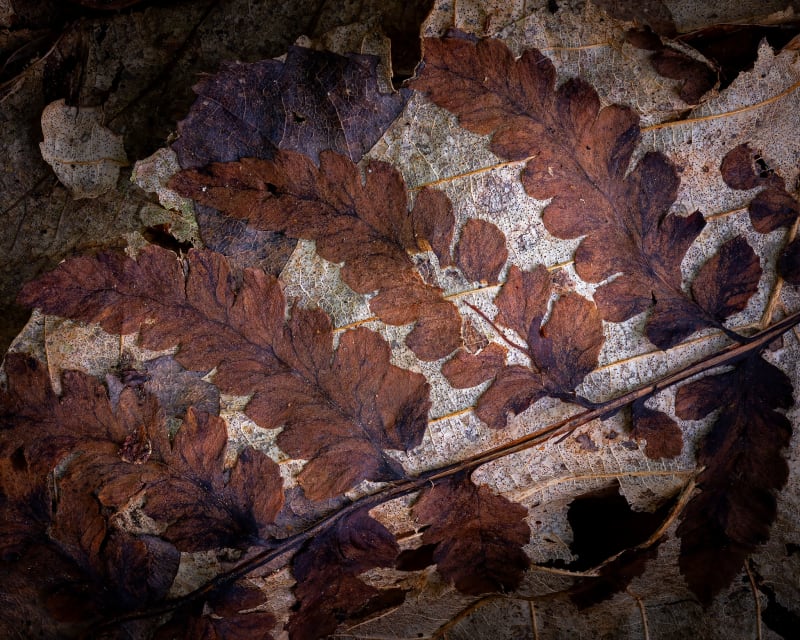
Marginal wood fern ((Dryopteris marginalis)
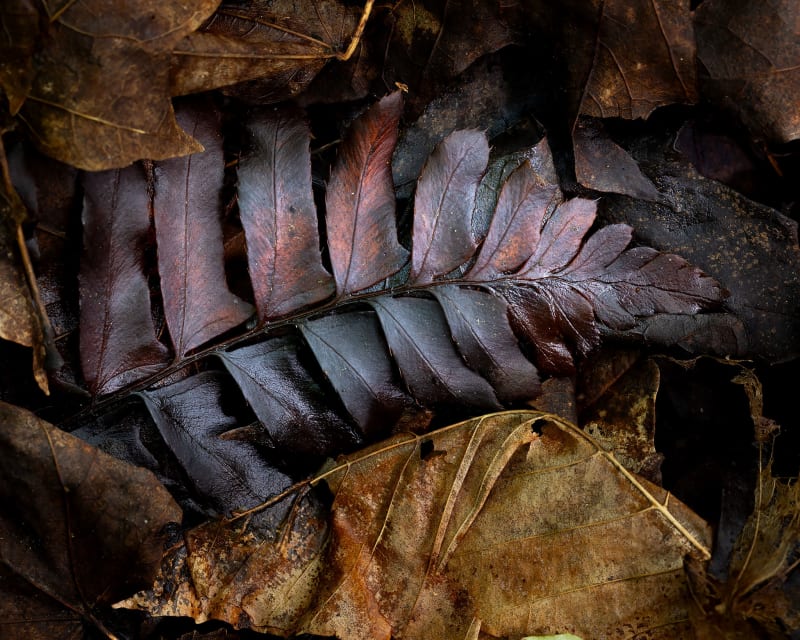
Christmas fern (Polystichum acrostichoides)
As autumn progresses and the beautiful display of colorful leaves on the trees has fallen to the ground, their beauty still persists. Yes, the leaves on the ground will still show their color for some time, but the underside of those leaves can be as amazing as the top, and the changes that occur as they progress through the stages of decay can be as amazing to observe as the fall colors themselves. The underside of maple leaves (Sapindaceae), especially red maples, can vary widely from purple, yellow, white, and brown, with boldly colored veins of red, black, and even gold. Sugar maple leaves can be wonderful shades of orange to pink, or even an aqua‑green, with bold gold veins. American linden/basswood (Tilia americana) leaves are often a very rich rust color with bold veins, but can also appear tan, bright yellow, or golden. These three species are very common in the woods of Pennsylvania and are a tiny sample of the deciduous tree species worth seeking out while hiking through the forest.
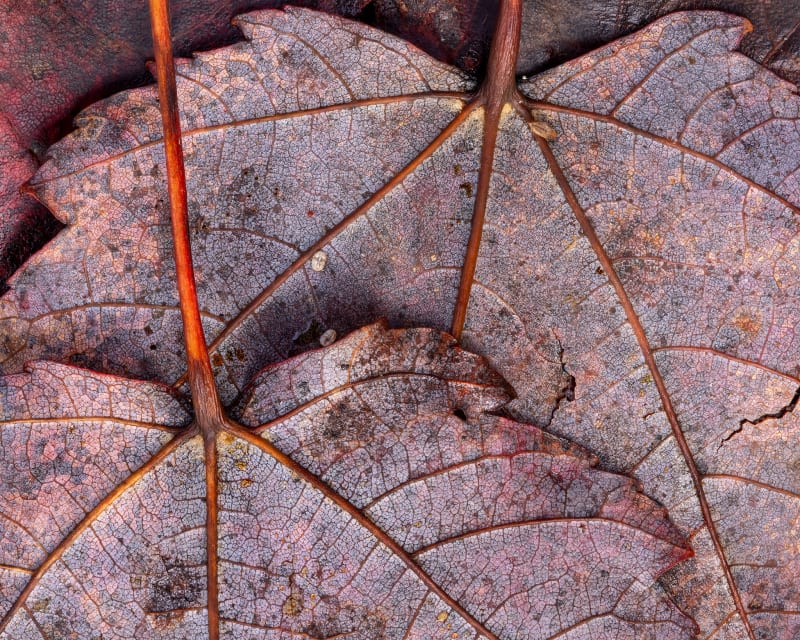
Red maple (Acer rubrum)
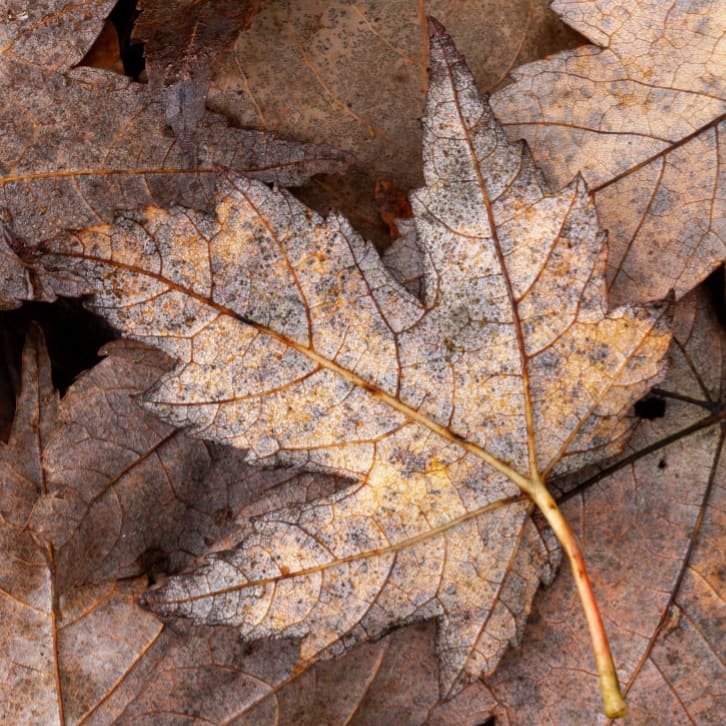
Red maple (Acer rubrum)
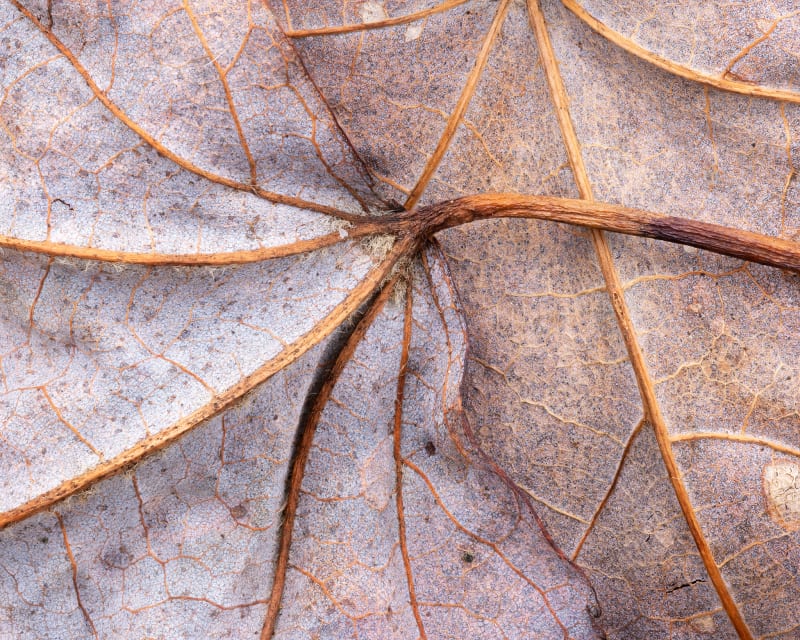
Red maple (Acer rubrum)
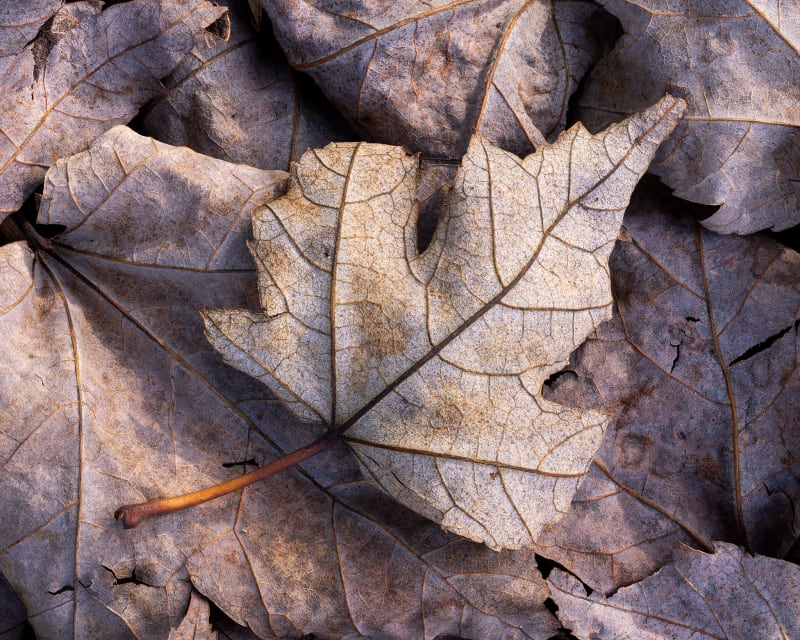
Red maple (Acer rubrum)
The next time you are in the forest, look where you typically may not look. Peek underneath the big, green fern fronds, or observe what remains of the previous season’s fronds. Scan the decaying leaves on the ground and see what you can find. Look for shapes, patterns, and colors, as well as the variety of organisms that are dependent on the remnants of one plant’s life for its own shelter and on the decay for nourishment. While I have focused on toppled fern fronds and the fallen leaves of the trees, plants still standing that no longer have life flowing through them are all around, and just as amazing to observe as when they were green and lush. The nutrients they spent a lifetime accumulating will soon provide nourishment for the living forest.
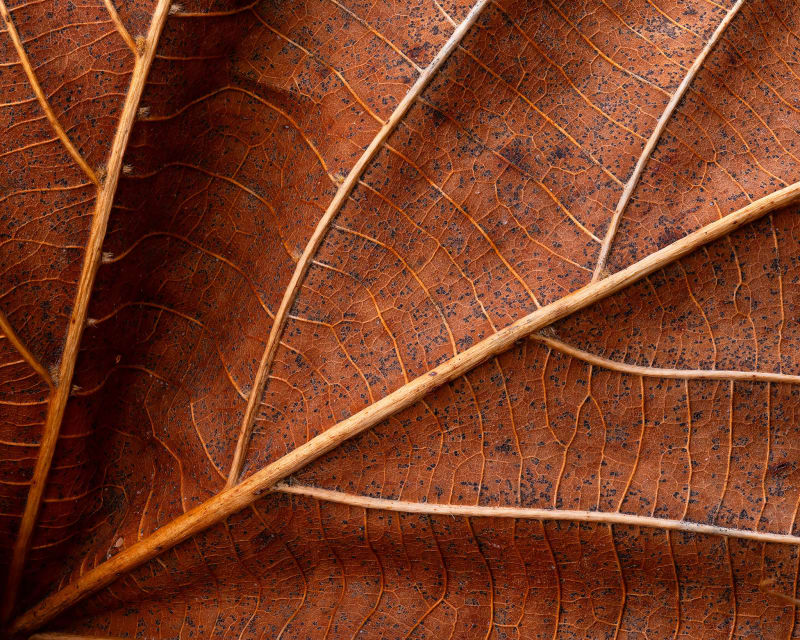
Basswood (Tilia americana)
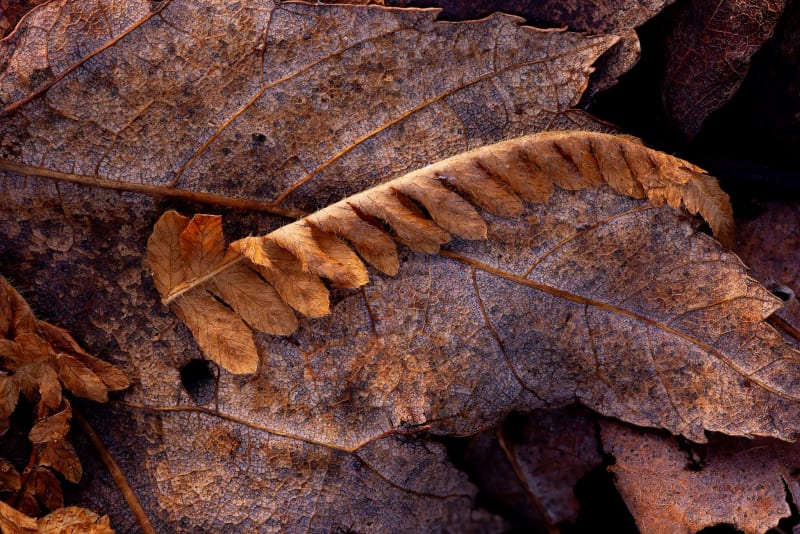
New York fern (Amauropelta noveboracensis)
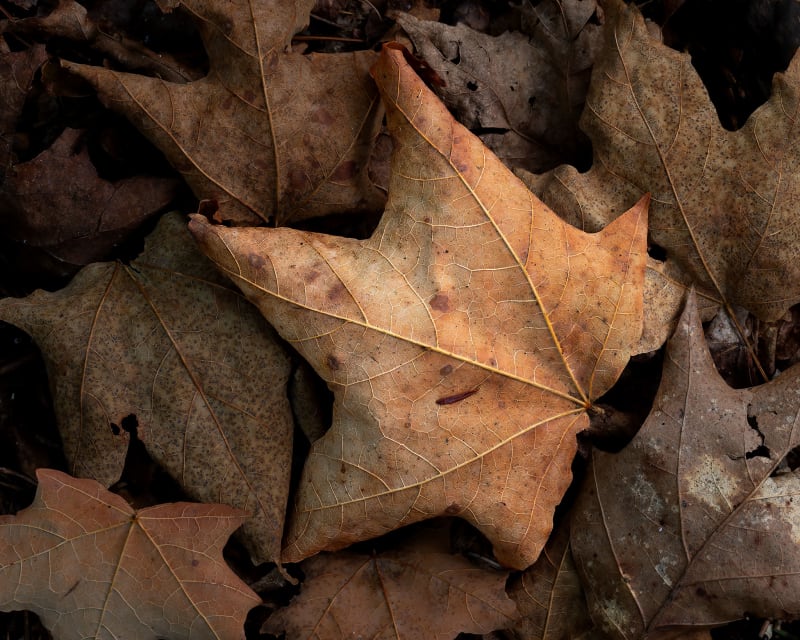
Sugar maple (Acer saccharum)
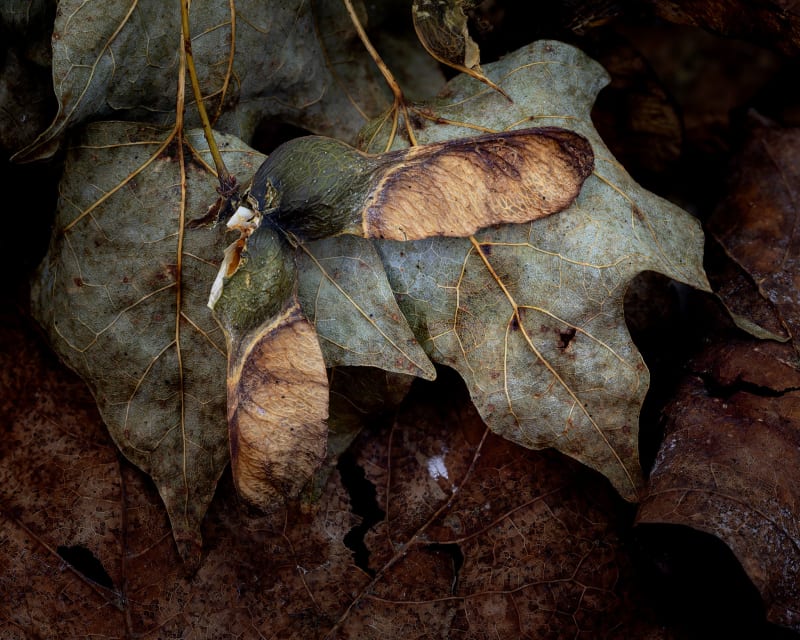
Sugar maple (Acer saccharum)
This amazing world can be witnessed year‑round. It is there amongst the spring ephemerals, the heat of summer, and it can still be found during the seemingly lifeless winter. So watch your feet; no matter how lifeless the forest appears to be, there is always life and beauty to be found as the cycle of life continues to contribute to the health of our amazing Pennsylvania forests.