Calla palustris
A white wetland flower blooming through the summer
Calla palustris wild calla

 Add to MyPlants
View Distribution
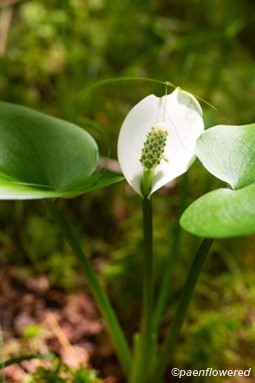
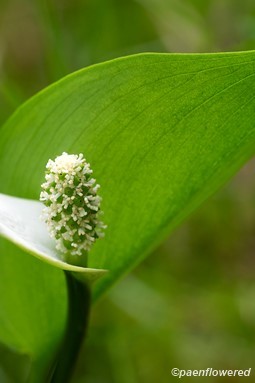
The flowering structure has a broad petal-like modified leaf called the spathe that partially clasps a short golden spadix. The edges of the spathe are often folded. It is green on the outside and white on the inside. The close to one-inch spadix is covered with tiny yellow flowers. The dark green leaves are heart-shaped and about 6 inches long. The fruit is a cluster of red berries that forms in late summer. These resemble the berries formed by the Jack-in-the-pulpit plant. Wild calla grows in cool bogs, and on the edges of ponds. It often grows out of the muck at the bottom of shallow bodies of water.
The plant grows 5 to 12 inches tall with the leaves held out of the water on long petioles. Wild calla is a northern species found from Alaska and across southern Canada and the northern United States as far south as Maryland. It is also found in northern Eurasia. In Pennsylvania it is more common in the northern counties, but has also been historically documented in Butler and Somerset Counties.
The blooming period is May to August. The plant used to be abundant in the United States but many populations have suffered from swamp drainage and other habitat degradation. The roots are edible but must be prepared by drying, grinding and heating to remove the acrid chemicals. In early America the root powder was used to make herb cookies when food was scarce. Other common names for this plant are the water arum and bog arum.
Habitat & Range
Occasional in swamps, bogs, fens and marshy ponds. Prefers partial or dappled shade and permanently wet, humus‑rich, acidic soil.
Mostly found in the north of the state and Somerset county in the south-west.
Range: Native across the temperate and subarctic Northern Hemisphere, from northern Eurasia through Alaska and Canada to the northeastern United States, extending south to Maryland and parts of the upper Midwest.
| EMP: | OBL |
|---|---|
| NCNE: | OBL |
Phenology
Flowers May to August. Bloom duration is 2 to 3 weeks.
Characteristics
Inflorescence yellow, short, cylindrical spadix enclosed by a white, open spathe (bract); spadix 0.4-0.8″ long
Flowers tiny, yellow, lacking petals; densely packed on the spadix
Leaves heart to kidney shaped, thick, waxy, smooth; medium to dark green; margins entire, edges curl inward; 2-6″ long, 1.5-4″ wide; petioles stout, 3-8″ long
Stems smooth, green, erect, fleshy; arise from creeping rhizomes
Rhizomes creeping, spreading slowly outward; forms mats and large colonies
Fruit brigth red ovoid berry; ½″ across; seeds few
Height 4 to 12 inches
Plant Codes
S-rank: S4 (Apparently Secure)
G-rank: G5 (Secure)
Ecology
Pollinated mainly by staphylinid and hydrophilid beetles, with syrphid and small carrion flies also visiting the flowers.
Young shoots are occasionally eaten by black bears, but the leaves and berries contain sharp calcium oxalate crystals and are strongly irritating, so most wildlife avoids them.
The plant's creeping rhizome network helps stabilize saturated soils and contributes to the structure of bog and fen wetlands.
Calla palustris wild calla


Comments
Have you spotted this plant in your area? We'd love to hear about your experience! Share your comments or questions about the plant below. Comments are moderated before posting.