Zizia aurea
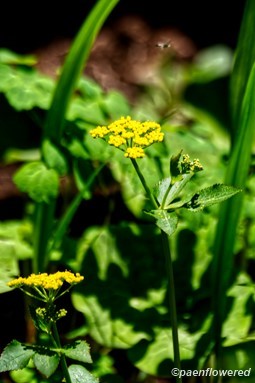
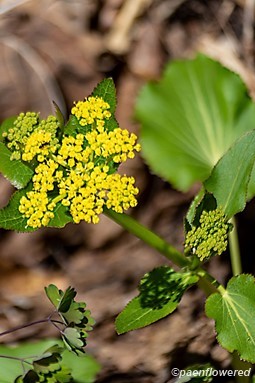
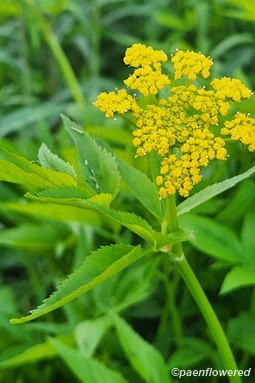
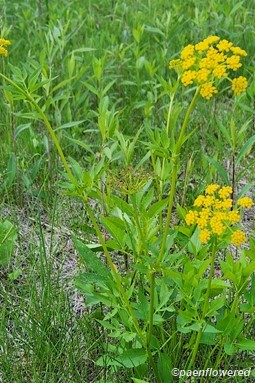
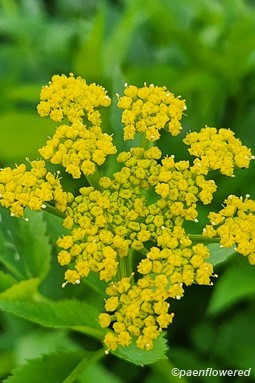
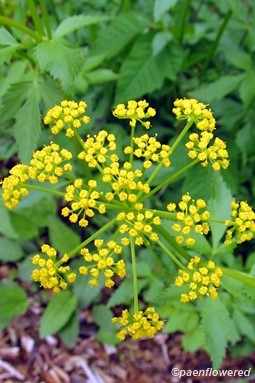
A native zizia with a flat cluster of small, bright yellow flowers
Zizia aurea golden alexanders

 Add to MyPlants
View Distribution
Add to MyPlants
View Distribution
This colorful, lace-like, native perennial wildflower is a member of the parsley or carrot family. The flat cluster of small yellow flowers is in the form of a flat or slightly rounded umbel about 2-3 inches wide. The umbel is divided into about 12 smaller clusters, each with about 21 individual flowers. Each flower is only 1/8 inch wide and has five incurved petals, five sepals and 5 stamens.
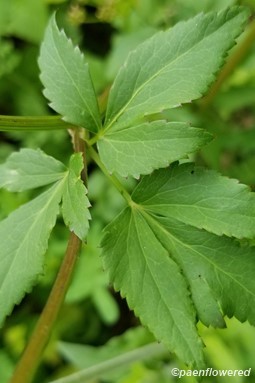
The flowers attract a variety of insects. They can serve as pollinators but the plant can also self-fertilize. The flowers have no scent. Each flower eventually produces an oblong green capsule. The capsules change color as the season progresses. The leaves have a variable shape but are doubly compound. Each is divided into three parts and these are divided into 3-7 narrow or ovate toothed leaflets. The lower leaves have longer petioles than the upper leaves. The stems are often red tinged and there are occasional side branches. In the fall both the leaves and the fruit turn purple.
The plant grows to a height of 1½-3 feet and blooms from late April to June. It can be found in meadows, moist woods, roadsides, swamps, thickets and on shorelines. The plant prefers full sun but will tolerate some shade.
This species can be a tricky one to identify as several other plants have a similar appearance and are also called golden alexanders. These include the yellow meadow parsnip (Thaspium trifoliatum) that has heart-shaped basal leaves, wild parsnip (Pastinaca sativa) that blooms later and has more leaflets, Zizia aptera that also has heart-shaped basal leaves and central flowers in each small cluster that have no stalk, and yellow pimpernel (Taenidia integerrima) that has leaves with no teeth. For this reason, some use the common name golden zizia, rather than golden alexanders for Zizia aurea.
Habitat & Range
Grows along stream banks, in moist meadows, thickets and limestone glades. Prefers full sun to part shade and moist, well-drained soils.
Present throughout the state.
Range: Native to eastern and central North America, from southeastern Canada south to the Gulf states and west to the Great Plains.
| EMP: | FAC |
|---|---|
| NCNE: | FAC |
Phenology
Flowers May through June. Bloom duration is 3 to 5 weeks.
Characteristics
Inflorescence compound umbels at tips of stems; each umbellet many-flowered, with central flowers sessile; each umbel 2 to 3″ across
Flowers tiny, bright yellow flowers; 5 incurved petals; 5 sepals, 5 stamens; ⅛″ across
Leaves alternate, compound, shiny, glabrous; odd-pinnate with 3 to 5 leaflets; leaflets lanceolate to ovate with serrated margins, 3″ long, 2″ wide
Stems glabrous, shiny, light green, can have red tinge; sometimes lateral
Fruit oblong schizocarp, flattened, with 2 seeds; seeds small, brown, ribbed, with 5 angular ribs
Height 1.5 to 3 feet
Identification Tips
Central flower in an umbellet is sessile.
No basal leaves present as in Z. aptera
Plant Codes
S-rank: S5 (Secure)
G-rank: G5 (Secure)
Medicinal Qualities
Golden-alexanders has a history of traditional medicinal use among Indigenous communities. A tea made from the root was used as a febrifuge, and preparations from the flower stalks were used for headaches. These uses are historical and the plant is now considered somewhat toxic for internal medicinal applications.
The young flowers are edible and can be cooked and eaten like broccoli.
Ecology
Mining bees, including the specialist Andrena ziziae, rely on the pollen of Z. aurea. Its open, accessible umbels attract a wide range of nectar‑seeking insects such as flies, wasps, native bees, beetles, and butterflies.
The foliage serves as a larval food source for Black Swallowtail caterpillars, and in the Ozarks, for the rare Ozark Swallowtail as well.
By supporting both specialist pollinators and early‑season herbivores, Zizia aurea contributes to meadow and woodland‑edge food webs.
Zizia aurea golden alexanders


Comments
Have you spotted this plant in your area? We'd love to hear about your experience! Share your comments or questions about the plant below. Comments are moderated before posting.