Epifagus virginiana
Epifagus virginiana beechdrops

 Synonyms:
Leptamnium virginianum
Synonyms:
Leptamnium virginianum
Add to MyPlants View Locations
Epifagus virginiana (beechdrops) is a distinctive holoparasitic wildflower found only in the beech forests of eastern and midwestern North America. Entirely lacking chlorophyll, it lives by attaching to the roots of American Beech and drawing all of its nutrients from the host. Because it depends completely on this root connection, beechdrops cannot survive away from beech trees and appears only where their root systems extend.
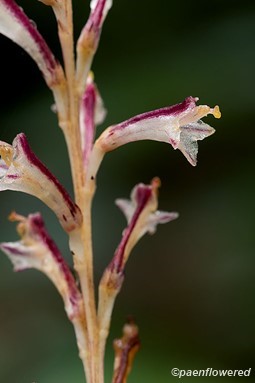
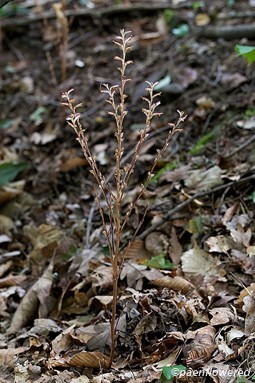
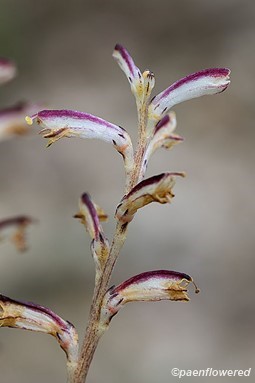
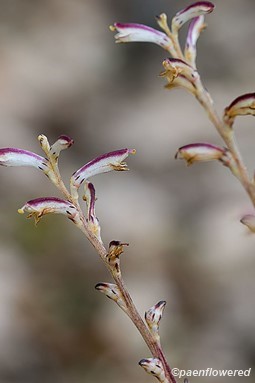
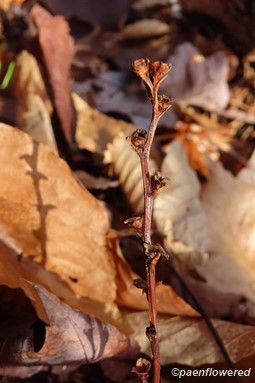
Beechdrops begins its life when a seed germinates in response to chemical signals from the roots of an American Beech. From the beech root system, the plant sends up brownish, unbranched stems 4–18 inches tall, bearing small white‑and‑purple tubular flowers about 8 mm long on the upper part of the stem. The flowers emerge directly from the stem, each with four lobes and a curved or slightly arching tube, while the leaves are reduced to tiny, triangular, scale‑like structures between the flowers.
Both leaves and flowers are attached directly to the stem, arranged alternately from the woolly, tuberous base to the tip. A distinctive feature of Epifagus virginiana is that the lower, cleistogamous flowers are self‑pollinating, while the upper, chasmogamous flowers open and can be cross‑pollinated.
Even when beechdrops forms large colonies beneath beech trees, it is often overlooked because of its small size, brownish stems blending with fallen leaves, and its ghostlike, chlorophyll‑free appearance.
Epifagus virginiana blooms from late summer into fall (July–October), but its flowers attract only a few small insects, including occasional long‑tongued bees and winter ants. Because most of its flowers are cleistogamous and self‑pollinating, it plays only a minor role in supporting pollinators, though it remains an integral part of beech‑forest ecology.
Native Americans used Epifagus virginiana to make a tea traditionally used for diarrhea, dysentery, and mouth sores.
Habitat & Range
Frequent in mesic woodlands, especially beech–maple forests and other hardwood stands with strong beech presence. Grows in deep shade with moderate, consistent moisture.
Present in most parts of the state except a few central counties.
Range: Native to eastern and midwestern North America, extending from Maine to Florida, west to the Midwest, and north into southern Canada.
Wetland Code: Not classified
Phenology
Flowers July to October. Bloom duration is 2 to 3 weeks for open flowers and up to 5 weeks for closed, self-pollinating flowers.
Characteristics
Inflorescence simple, spike-like; creates appearance of solitary flowers on upper stem
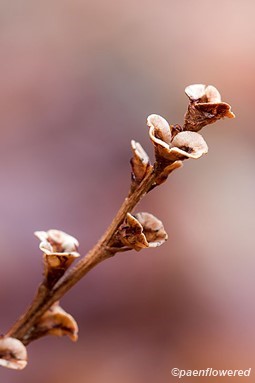
Flowers sessile, subtended by tiny bracts; upper(chasmogamous) flowers white and purple, tubular with curved or slightly arching tube, fertile, 4 lobes, abt. ⅓ ″long; lower (cleistogamous) minute, closed, highly reduced, self-fertilizing and hidden among lower bracts
Leaves(bracts) triangular, alternate, scale-like, minute bracts; subtending or sitting just below a flower
Stems simple, erect, brownish when mature; typically unbranched, occasionally with a few short ascending lateral branches; wooly at the base, glabrous elsewhere
Fruit tiny, dry, dehiscent capsule; seeds numerous, dust-like
Height 4-18 inches
Plant Codes
S-rank: S5 (Secure)
G-rank: G5 (Secure)
Ecology
Flowers attract only a few small insects, including occasional long‑tongued bees, tiny flies, and winter ants, though most pollination occurs internally within the closed cleistogamous flowers.
Because the plant relies on self‑fertilization, it plays only a minor role in supporting pollinators. Its primary ecological significance lies in its holoparasitic relationship with American Beech, serving as a natural component of mature beech‑forest communities and reflecting the health, continuity, and age of these mesic woodland systems.
Epifagus virginiana beechdrops
Add to MyPlants View Locations

Comments
Have you spotted this plant in your area? We'd love to hear about your experience! Share your comments or questions about the plant below. Comments are moderated before posting.