Melampyrum lineare
Melampyrum lineare American cow-wheat

 Add to MyPlants
View Locations
Add to MyPlants
View Locations
American cow‑wheat is a herbaceous, hemiparasitic wildflower native to southern Canada and the northern United States, extending southward through the Appalachians. It is considered critically imperiled in Indiana and vulnerable in Ohio, but is secure and widespread in Pennsylvania, where it occurs in dry, open woods and rocky forest margins.
Although widespread in Pennsylvania, American cow‑wheat is easy to overlook. Its branching, 6–16 inch stems form loose, delicate clumps that blend into the understory. The plant grows in dry, open woods, along trails, and in light gaps beneath pine, maple, or poplar. As a hemiparasite, it relies on both photosynthesis and root parasitism, using specialized haustorial connections to draw nutrients from nearby host plants—an interaction essential for vigorous growth and flowering.
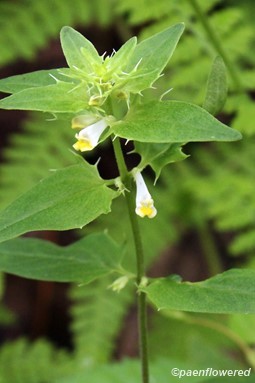
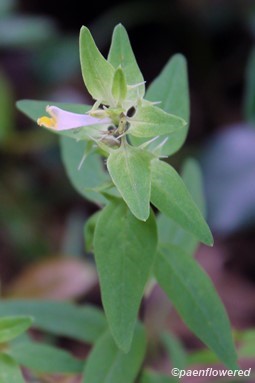
Once established, American cow‑wheat produces small, inconspicuous flowers on short stalks arising from the leaf axils of the upper branches. The surrounding bracteal leaves are narrow and lance‑shaped, with sharply pointed, triangular teeth along the margins. Each flower is about half an inch long and tubular, with an arched white upper lip that encloses the four stamens and a three‑lobed yellow lower lip that juts forward, giving the blossom a distinctive, snake‑head appearance.
The flowers attract bumblebees and small native bees for nectar and pollen, with butterflies visiting occasionally. After flowering, the seeds bear small, nutrient‑rich elaiosomes that attract ants, which carry the seeds back to their nests and aid in dispersal.
Very little has been recorded about the medicinal use of this species. One Iroquois source notes that an infusion of the plant was used as an eye wash, but documentation is limited and the practice appears to have been uncommon.
Habitat & Range
Grows in acidic woods, barrens, meadows and fields. Prefers full sun to part shade and dry to mesic, sandy or rocky soils.
Present throughout the state.
Range: Native to southern Canada and the northern and eastern United States, extending south through the Appalachian Mountains.
| EMP: | FACU |
|---|---|
| NCNE: | FACU |
Phenology
Flowers June to September. Bloom duration is 2 to 3 weeks.
Fruits July to October.
Characteristics
Inflorescence singular flowers arising from axils of upper bracteal leaves
Flowers corolla white with yellow palate, tubular, 2-lipped; lower lip 3-lobed, yellow; upper lip entire and arched enclosing 4 stamens, white; ½″ long
Leaves opposite, simple, linear to lance-ovate; lower leaves entire, upper bracteal leaves sometimes with small basal teeth; sessile or nearly so; ¾ to 2½″ long
Stems slender, 4‑sided; usually unbranched, glabrous to sparsely hairy
Fruit small, ovoid to oblong, 2‑valved dry capsule; 4–6 mm long; seeds few, smooth, brown to tan
Height 6 to 16 inches
Plant Codes
S-rank: S5 (Secure)
G-rank: G5 (Secure)
Ecology
Pollinated mainly by bumblebees and small native bees, with butterflies visiting occasionally.
Seeds carry elaiosomes that attract ants for dispersal. The plant hosts small insect herbivores and adds fine‑textured cover within open woods and clearings.
As a hemiparasite, it subtly shapes plant communities by drawing nutrients from nearby roots and thriving in the light‑filled gaps where many upland species coexist.
Melampyrum lineare American cow-wheat





Comments
Have you spotted this plant in your area? We'd love to hear about your experience! Share your comments or questions about the plant below. Comments are moderated before posting.