Lilium canadense
Lilium canadense Canada lily

 Add to MyPlants
View Locations
Add to MyPlants
View Locations
Commonly known as Canada lily or meadow lily, Lilium canadense is a native herbaceous perennial of eastern North America, present throughout Pennsylvania. Although locally affected by deer browsing, the invasive lily leaf beetle, and its naturally slow establishment, the species remains secure in our state. It is found throughout the state along streams, wet meadows and moist woods in partial shade.
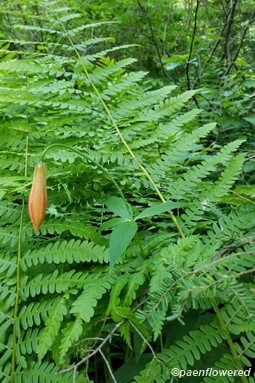
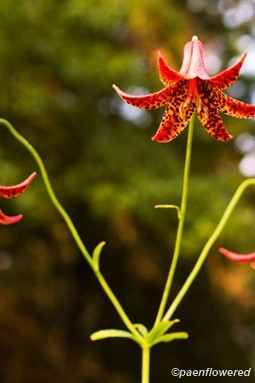
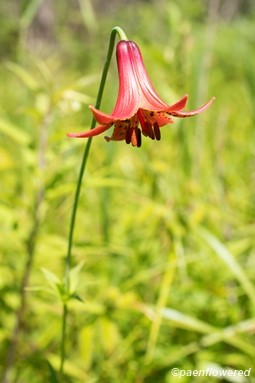
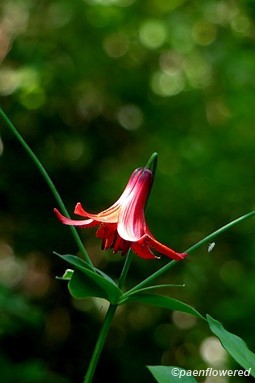
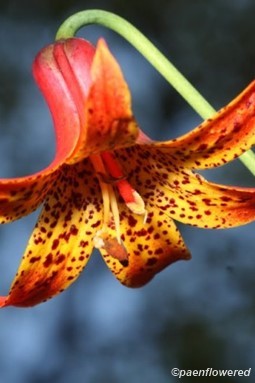
This attractive lily usually occurs in its orange form, though red and yellow forms also appear. The large, pendulous, downward‑hanging flowers are widely flaring, 3-4 inches long, and marked inside with dark purple‑brown spots. Blooming from June into July, each flower lasts about 7–10 days, and many may be borne on long stalks in a loose terminal cluster (raceme) atop the 2–5 foot stem. The smooth stem is encircled by whorls of long, narrow leaves that are dark green above and lighter beneath and may also form bracts just below the flowers.
Fritillary and swallowtail butterflies visit the large, nodding flowers for nectar and are likely the most effective pollinators. Halictid bees collect pollen but are generally too small to pollinate the deep, pendulous blooms. Hummingbirds may occasionally visit, but they are not considered primary pollinators of Lilium canadense.
It is recorded that this showy lily was seen by French explorers in the early 1600s and taken to Europe, where it was successfully grown in England and France. Thomas Jefferson admired the plant while living in France in 1786 and requested bulbs and seeds, which he shared with friends.
The bulbs of Canada lily were traditionally used in a limited set of medicinal applications. A poultice made from the bulbs was applied to snakebites, and a tea prepared from the bulbs was used as a stomachic and in the treatment of irregular menses and dysentery. Some groups also used a decoction of the tubers as a nutritive tonic for children.
Habitat & Range
Infrequent in moist woods and meadows, wooded slopes, wetland margins and clearings. Prefers partial or dappled sunlight in moist, well‑drained loamy or sandy‑loam soils.
Present throughout the state.
Range: Native of eastern North America with its range extending from Ontario to Nova Scotia south to Georgia and Alabama.
| EMP: | FAC |
|---|---|
| NCNE: | FAC |
Phenology
Flowers mid-June into July. Bloom duration is 2-3 weeks.
Characteristics
Inflorescence loose terminal raceme of several long‑pediceled, nodding flowers, often with bract‑like leaves just below
Flowers nodding, bell-shaped, large, 3-4″ long; perianth yellow, orange or red, with darker spots; 6 petal-like tepals spreading to recurved; 6 stamens surrounding 1 central pistil
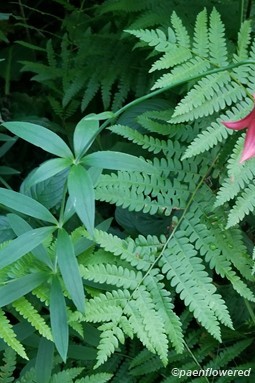
Leaves mostly in whorls of 3–8, with occasional alternate leaves between whorls; narrowly ovate, entire, sessile, parallel-veined; medium to dark green above and lighter green beneath; glabrous above and glabrous beneath except for minute hairs along the veins; 6″ long, abt. 1″ wide
Stems terete, glabrous, light green
Fruit oblongoid, erect, 3-valved dry dehiscent capsule; abt 1″ long; each valve with large stack of flattened seeds
Height 2-5 feet
Plant Codes
S-rank: S5 (Secure)
G-rank: G5 (Secure)
Ecology
Large butterflies such as swallowtails and fritillaries visit the nodding flowers for nectar, and bees collect pollen, though smaller bees are generally too small to pollinate the deep blooms effectively. Hummingbirds may visit, but most evidence points to insects as the primary pollinators.
Deer and rabbits browse the foliage, while voles and chipmunks feed on the underground bulbs. The invasive lily leaf beetle has recently been found feeding on native lilies, including Canada lily.
Growing in moist woods, wet meadows, and stream margins, the plant contributes nectar and pollen to partially shaded wetland‑edge communities and provides early‑summer structure and food resources within these habitats.
Lilium canadense Canada lily


Comments
Have you spotted this plant in your area? We'd love to hear about your experience! Share your comments or questions about the plant below. Comments are moderated before posting.