Smilax rotundifolia
Smilax rotundifolia roundleaf greenbrier

 Add to MyPlants
View Distribution
Add to MyPlants
View Distribution
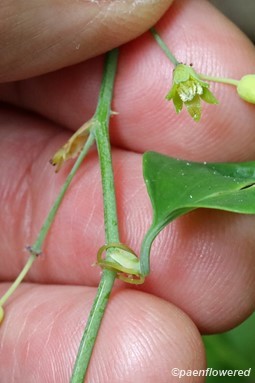
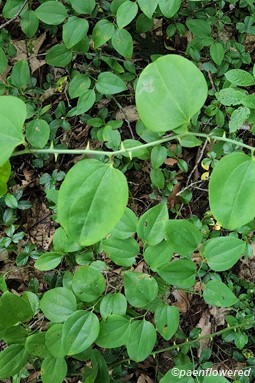
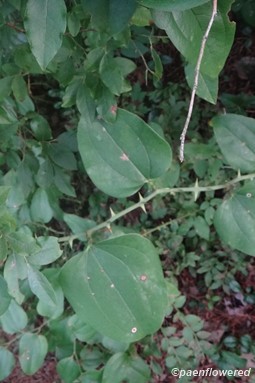
Smilax rotundifolia, roundleaf greenbrier, is a perennial woody vine native to the eastern and southeastern United States and southern Canada. In Pennsylvania it grows in a wide range of habitats, including moist to dry forests, woodlands, thickets, hedgerows, fields, and pond borders. This thorn‑armed vine climbs up surrounding vegetation or forms dense, tangled ground masses. Climbing is aided by green tendrils that arise from the bases of the petioles. Stems are round with faint angles, green to woody with age, and bear scattered prickles.
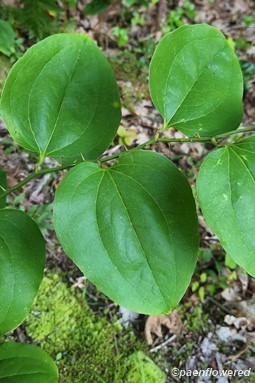
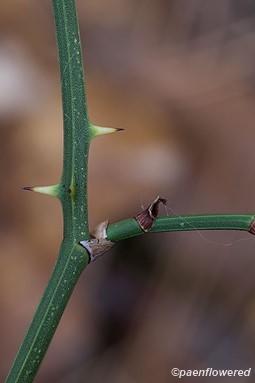
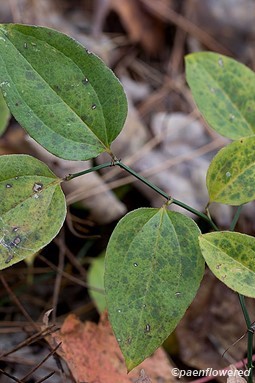
Prickles measure 2–6 mm long, pale with darker tips, and are not present on every stem. Leaves are alternate, rounded to broadly ovate, smooth, 1½–5" long, with smooth margins. The upper surface is glossy dark green; the lower surface is paler. Leaf stalks are ¼–½" long, light green, and smooth, with a pair of tendrils at the base.
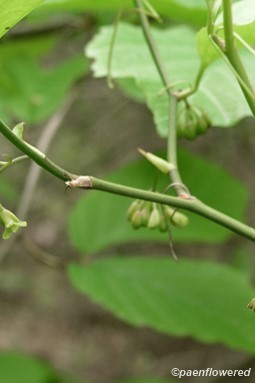
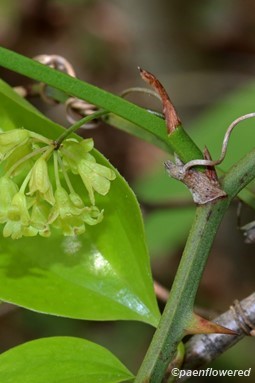
Roundleaf greenbriar is dioecious, with male and female flowers on separate plants. Flowers are yellow-green to greenish to white-greenish and small, typically ⅛–¼" (3–6 mm) long. Each flower has six green to greenish-white tepals, free or slightly united at the base. Male flowers bear six stamens with pale anthers, while female flowers contain a single pistil with three short, spreading stigmas. Flowers are arranged in axillary umbels of 3–15 (occasionally up to 20) blossoms, each umbel borne on a slender stalk arising from the leaf axils. This species blooms May to mid-June in Pennsylvania.
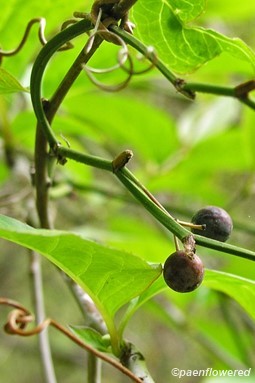
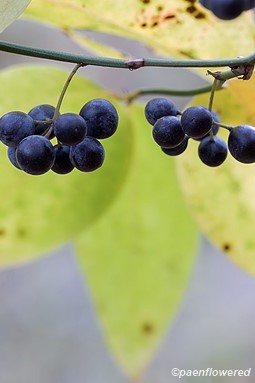
After fertilization, the female flowers develop into bluish‑black berries with a pale, whitish bloom. The fruits are about ¼" across, round, and contain 1–3 seeds. Berries often persist into late winter and provide food for northern cardinals, white‑throated sparrows, and other fruit‑eating birds.
The foliage is browsed by white‑tailed deer and rabbits, and serves as host material for several insects, including the Smilax leaf beetle, Smilax leaf midge, woolly maple aphid, Smilax stem gall wasp, the caterpillar of the false diamondback moth, and the Smilax leafminer moth. The flowers are pollinated by small bees, flies, and butterflies.
Roundleaf greenbriar reproduces both vegetatively and by seed. It spreads vigorously by lateral underground rhizomes, which send up new shoots that climb or sprawl to form dense, clonal thickets. This rhizomatous growth allows the species to expand rapidly across suitable habitat. Sexual reproduction occurs through the seeds contained in the berries. The fruits are eaten primarily by birds, which disperse the seeds to new locations, with occasional dispersal by mammals.
The young shoots, leaves, and tendrils of Smilax rotundifolia are edible. The tender spring shoots can be cooked and eaten much like asparagus, while the young leaves and tendrils can be prepared as mild greens or added raw to salads when very young.
Habitat & Range
Common in moist to dry woods, fields, thickets and barrens. Prefers part shade to full sun and well-drained soils.
Present in most counties of the state, except a few northern counties.
Range: Native to southern Canada and the eastern United States, extending west into the east‑central states.
| EMP: | FAC |
|---|---|
| NCNE: | FAC |
Phenology
Flowers late May to mid June. Bloom duration is 2 to 3 weeks.
Fruits September to winter.
Characteristics
Inflorescence axillary umbels of 3-15 flowers (rarely up to 20)
Flowers dioecious, greenish to white to greenish to yellow-greenish, small (⅛–¼" across); six pale yellow-green to greenish-white tepals
Staminate flowers six stamens with pale anthers
Pistillate flowers one pistil with three short, spreading stigmas
Leaves alternate, ovate to ovate-lanceolate with rounded, cordate or truncate base; margins entire; semi-evergreen; 3-5 main veins with small prickles sometimes present along on the underside; petioles with pairs (occasionally one) of tendrils at base; 1½–5" long, 1½–4" wide
Stems round to faintly angled, green; clibms with tendrils from petioles; prickles broad-based
Fruit bluish-black berry with whitish bloom; each berry has 1 to 3 seeds; ¼″ across
Rhizomes spreads by long, creeping underground rhizomes that send up new shoots at intervals
Height 10-20 feet, can climb to 30 feet or more
Plant Codes
S-rank: S5 (Secure)
G-rank: G5 (Secure)
Ecology
The flowers are pollinated by small bees, flies, and butterflies, which visit the pale yellow‑green umbels for nectar. The foliage supports several specialist and generalist herbivores, including the Smilax leaf beetle, Smilax leaf midge, woolly maple aphid, Smilax stem gall wasp, the caterpillar of the false diamondback moth, and the Smilax leafminer moth.
The leaves are occasionally browsed by white‑tailed deer and rabbits, and the dense, arching thickets provide shelter for birds and small mammals. The berries are eaten by fruit‑eating birds, with small mammals such as rabbits also taking some fruit.
By forming dense, protective tangles along forest edges and understories, roundleaf greenbrier shapes local structure and offers year‑round cover and food resources, fitting naturally into thickets, hedgerows, and woodland margins across Pennsylvania.
Smilax rotundifolia roundleaf greenbrier




Comments
Have you spotted this plant in your area? We'd love to hear about your experience! Share your comments or questions about the plant below. Comments are moderated before posting.