Ludwigia palustris
Ludwigia palustris marsh seedbox

 Add to MyPlants
View Locations
Add to MyPlants
View Locations
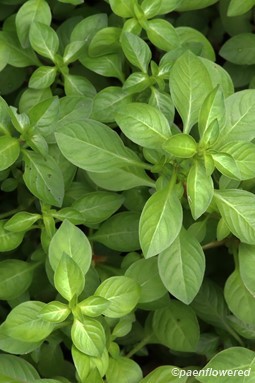
Marsh seedbox is a mat‑forming, herbaceous plant native to much of North America and widely distributed across other continents. It grows in muddy soils, marshes, shorelines, riverbanks, and sandbars, often forming low, creeping mats 3–12 inches tall. Its red stems and tiny green, petalless flowers are easily overlooked. Depending on water levels, it may grow submerged with only the stem tips visible, or spread across exposed mudflats where it is often mistaken for a weed.
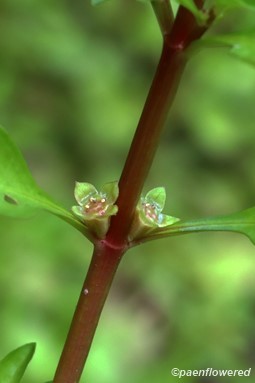
The ⅛ inch greenish-cream-colored flowers are almost unseen, with only one flower growing at the axis of every leaf, and 4 pointed lobes flaring outward from the cup-shaped calyx.
Leaves are opposite, green, and round to oval, often developing pinkish or reddish tones in strong sunlight; the roots share this pinkish cast.
Although its tiny, petal‑less flowers attract few pollinators, marsh seedbox plays an important ecological role in aquatic habitats. Its dense mats provide shelter for midges, mayfly nymphs, small beetles, freshwater shrimp, and amphipods, and offer cover for tadpoles, frogs, and salamanders. Because of its red stems and ability to grow submerged, it is also widely used in aquariums.
Habitat & Range
Common in swamps, along streams and in wet ditches. Prefers full sun to partial shade and wet, muddy or saturated soils.
Present throughout the state.
Range: Native to North America, occurring from North America through Central and South America, Europe, the Mediterranean, Iran, Central Eurasia, Africa, and Asia.
| EMP: | OBL |
|---|---|
| NCNE: | OBL |
Phenology
Flowers July to September.
Characteristics
Flowers yellow-green, single, sessile in leaf axils; no petals; calyx cup-shaped with 4 pointed lobes, lobes semi-oval to triangular and flare outward
Leaves opposite, round to oval to elliptic; margins entire; dull to bright green, can be reddish; tapering to a winged stalk; ½–1½″ long, up to ¾″ wide
Stems prostrate, creeping, or partially floating; succulent, red
Root System roots form continuosuly at nodes; rootlets form near axis of lower leaves; root system is fibrous and shallow
Fruit dehiscnet capsule with 4-angled sides, angles rounded; ¼″ long; seeds visible through walls
Height 3 to 12 inches
Plant Codes
S-rank: S5 (Secure)
G-rank: G5 (Secure)
Ecology
Muskrats feed on the foliage and waterfowl may help disperse its tiny seeds when they cling to feathers or feet. Dense mats provide shelter for small animals.
Flowers may attract small beetles.
Ludwigia palustris marsh seedbox


Comments
Have you spotted this plant in your area? We'd love to hear about your experience! Share your comments or questions about the plant below. Comments are moderated before posting.