Lycopus americanus
One of the more common horehounds with white tubular four-petaled flowers
Lycopus americanus American bugleweed

 Add to MyPlants
View Locations
Add to MyPlants
View Locations
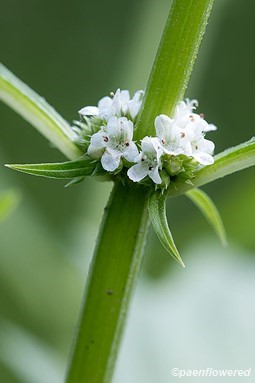
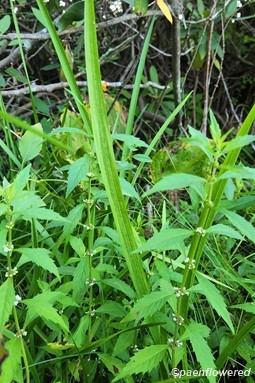
This native member of the mint family is a summer flower of moist or wet places like shorelines and wetlands. The small (⅛ inch) white tubular flowers appear 4-lobed and found in small clusters along the stem in the opposite leaf axils. There are two included stamens and one pistil. The light green calyx has five narrow sharply pointed lobes. As in most mints, the stem is square.
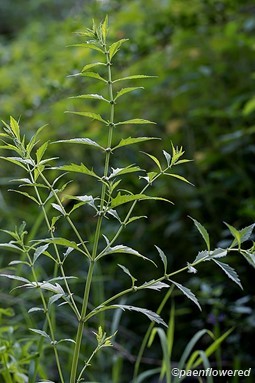
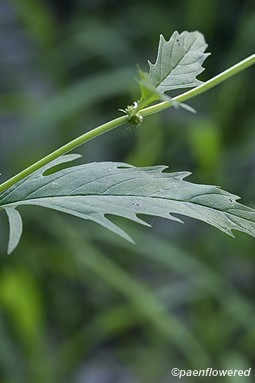
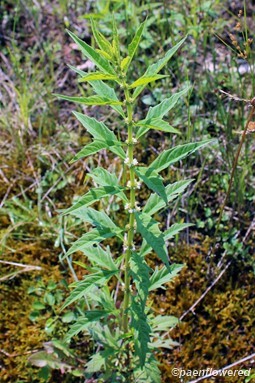
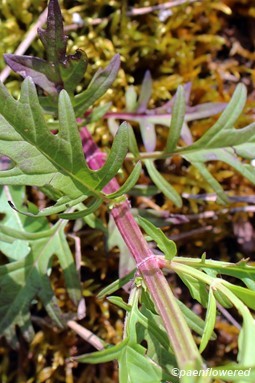
Leaves lanceolate to almost linear and sharply toothed with lower leaves sometimes more deeply toothed or shallowly lobed. The plant grows 6-24 inches high and blooms from June to September. It is not aromatic. This species can form vegetative colonies through the growth of its rhizome. This species is widespread in the northeastern and north‑central United States, extending westward and southward with more scattered populations.
This plant has been used as a source of dye and is reputed to have medicinal qualities. It is sometimes called the American water-horehound or the cut-leaved water-horehound. The closely related Northern water-horehound (L. uniflorus) has lower leaves toothed but not lobed and has flowers with always four calyx lobes. The latter species is often called the Northern bugleweed. There are 6 other Lycopus species in this area that are difficult to distinguish, but these two are the most common. Horehound-flavored candy is made from a Eurasian species of mint called Marrubium vulgare.
Habitat & Range
Common on shaded hillsides, fields, moist thickets, wet ditches, pond margins and swamps. Prefers full sun to light shade and saturated to seasonally flooded soils.
Present throughout the state.
Range: Native to most of North America, from Canada through the United States and into northern Mexico.
| EMP: | OBL |
|---|---|
| NCNE: | OBL |
Phenology
Flowers June to September. Bloom duration is 3 to 4 weeks.
Characteristics
Inflorescence dense axilary clusters forming tight whorls of very small, white, short-tubular flowers
Flowers very small (⅛″ long), white, sometimes with faint pinkish tinges, short‑tubular; corolla with 4 short spreading lobes, dinstictly exceeds the calyx; 2 included stamens, 1 pistil; calyx hairless, with 4 to 5 narrow triangular to subulate lobes, each sharply pointed
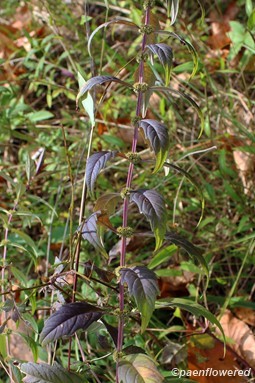
Leaves medium green, lanceolate to ovate‑lanceolate; short‑petioled to nearly sessile; upper leaves sharply toothed, lower leaves more deeply toothed or shallowly lobed toward the base; 3½″ long, 1½″ wide
Stems erect to ascending, usually simple or sparsely branched; green to reddish, 4-angled with slight ridges; smooth to slightly pubescent
Rhizomes slender, creeping, perennial; stolons short, without tubers
Fruit dry schizocarp with 4 obovoid, flat-topped small nutlets; one seed per nutlet
Height avg. 1 to 2½ feet; max 3 feet
Plant Codes
S-rank: S5 (Secure)
G-rank: G5 (Secure)
Ecology
Short‑ and long‑tongued bees, small wasps, and various flies visit the flowers for nectar. The foliage may host occasional generalist herbivores, but no specialist Lepidoptera are known to use this species.
Mammals rarely browse this plant because of its bitter taste.
American bugleweed grows in saturated soils of open wetlands where its creeping rhizomes help it form loose colonies in soft, mucky ground.
Lycopus americanus American bugleweed
.jpg?v=638934181820000000)



Comments
Have you spotted this plant in your area? We'd love to hear about your experience! Share your comments or questions about the plant below. Comments are moderated before posting.