Lycopus uniflorus
Lycopus uniflorus northern bugleweed

 Add to MyPlants
View Locations
Add to MyPlants
View Locations
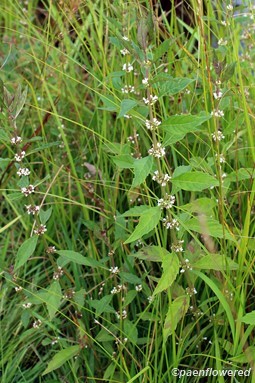
Lycopus uniflorus, or Northern bugleweed, is a native perennial in the mint family. Like other bugleweeds, it blooms from July to September, producing small white flowers in tight clusters in the leaf axils. Each flower has 1 pistil and 2 stamens, the stamens typically not extending beyond the corolla. The light green, short‑tubular calyx, usually with 4 teeth (rarely 5), helps distinguish this species from its close relatives. After the blooming period, the flowers develop into a set of four obovoid, flat‑topped nutlets.
The leaves are medium to dark green, sometimes with a purplish tint, and are lanceolate to elliptic in shape. They are hairless or only sparsely hairy and occur in opposite pairs along a green, square, smooth stem. The margins are finely serrated with numerous small teeth, and the leaves taper to a wedge‑like base and a pointed tip.
Although this plant may reach up to 3 feet tall, its stems are often weak and tend to sprawl or lean rather than remain fully erect. The plant spreads vegetatively by long, creeping stolons that root at the nodes, allowing it to form loose colonies. It is found in moist habitats such as marshes, swamps, wet meadows and along streams or lakes. It is most widely distributed in the northern part of North America and is found across Pennsylvania.
This plant is an important indicator of wetland ecosystems, classifying as an obligate wetland species. Not to be confused with L. americanus, which has deeply lobed lower leaves, or L. virginicus, which has wider leaves that abruptly taper toward the base and can be more hairy underneath.
Habitat & Range
Common in moist meadows, marshes, swamps and along lakes. Prefers full sun to part shade and very wet to saturated soils. Grows best in loamy, mucky or peaty soils.
Present throughout the state.
Range: Native to northern North America and northeastern Asia, including Canada, the northern United States, China, Japan, Korea, and the Russian Far East.
| EMP: | OBL |
|---|---|
| NCNE: | OBL |
Phenology
Flowers July to October. Bloom duration is 2 to 3 weeks.
Characteristics
Inflorescence loose axillary clusters forming open whorls of very small, white, short‑tubular flowers
Flowers very small, white (sometimes with faint pinkish tinges), short‑tubular; corolla with 4 short spreading lobes; 2 included stamens, 1 pistil; calyx light green with 4 broadly triangular, slightly spreading lobes; corolla tube barely exceeding the calyx
Leaves opposite, lanceolate to oblong, tips pointed; medium to dark green, smooth to sparsely pubescent; teeth small, shallow, widely spaced; 1-3″ long, abt 1″ wide
Stems erect, unbranched or few short branches; green, square, smooth
Rhizomes slender, creeping, perennial; stolons long, with tubers, root freely at nodes; produce scattered, clonal stems
Fruit dry schizocarp with 4 obovoid, flat-topped, smooth, small nutlets; one seed per nutlet
Height 1 to 1 ½ feet tall avg.; max 3 feet
Similar Species
L. virginicus leaf margins have coarser, more frequent, sometimes shallowly lobed teeth, while leaf margins of L. uniflorus have small, widely spaced, unlobed teeth.
L. virginicus calyx has 5 lobes while L. uniflorus's has 4.
L. virginicus has broader leaves that taper more abruptly at the base and are often sparsely hairy beneath, while L. uniflorus has narrower, smoother leaves.
Plant Codes
S-rank: S5 (Secure)
G-rank: G5 (Secure)
Ecology
Short‑ and long‑tongued bees, small wasps, and various flies visit the flowers for nectar.
Muskrats may consume the roots, but the foliage is rarely browsed by mammals due to its bitter taste.
Northern bugleweed is closely associated with saturated soils in open wetlands such as marshes, bog edges, wet meadows, and pond or stream margins, where its creeping stolons root readily in soft, mucky ground and enable it to form loose colonies.
Lycopus uniflorus northern bugleweed


Comments
Have you spotted this plant in your area? We'd love to hear about your experience! Share your comments or questions about the plant below. Comments are moderated before posting.