Agalinis purpurea
Agalinis purpurea common agalinis

 Add to MyPlants
View Locations
Add to MyPlants
View Locations
Common agalinis is an annual in the broomrape family (Orobanchaceae) native to the eastern United States and southeastern Canada. In Pennsylvania, it grows in wet meadows, bogs, fens, marsh edges, lakeshores, and serpentine barrens, typically reaching 2–4 feet in height with a branched, open habit about 1 foot across.
This species blooms from mid July through September, producing tubular, pink to purple flowers that arise from the leaf axils along the branching stems. Each flower measures ¾–1 inch long and about 1 inch across at the open end. The corolla has five spreading lobes, the upper two smaller than the lower three, and all are finely hairy.
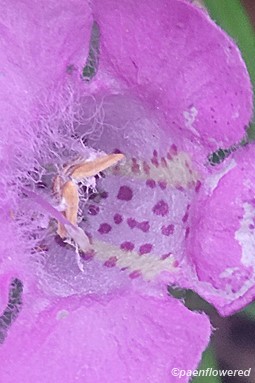
The throat of the flower is spotted purple with yellow lines, and the interior contains four hairy, white‑tipped stamens and a slender white style that is about the length of, or slightly longer than, the floral tube.
The calyx is hairless, with five pointed lobes that are one‑third to one‑half as long as the tube.
The leaves are opposite along the stem and linear to linear‑lanceolate in shape, measuring 1–3 inches long with a prominent midrib and smooth margins. The upper surface can feel slightly rough and may show a purplish tinge, especially in strong sun or dry periods.
This plant is hemiparasitic, forming root connections (haustoria) with nearby grasses and other herbaceous (rarely woody) plants to supplement its water and nutrient intake while still photosynthesizing on its own. Agalinis purpurea is pollinated primarily by native bees, with occasional visits from butterflies such as the Common Buckeye, contributing to the ecological diversity of open wetlands.
Common agalinis spreads by seed, producing a small round capsule that develops from the flower’s ovary. As the capsule dries, it splits open and releases numerous tiny seeds, which fall to the ground and may be moved short distances by wind or water.
Habitat & Range
Occasional in moist sandy fields, wet meadows, marsh shores, rocky shores and serpentine barrens. Prefers full sun to light shade and moist to wet soils.
Mostly found in the south east of the state.
Range: Native to the eastern United States and southeastern Canada, including New York, Pennsylvania, and the Great Lakes region.
| EMP: | FACW |
|---|---|
| NCNE: | FACW |
Phenology
Flowers mid July through September. Bloom duration is 2 to 3 weeks.
Characteristics
Inflorescence solitary, short‑stalked flowers arising from the leaf axils near the top of the plant and along the branching stems
Flowers corolla pink to purple, tubular, ¾ -1″ long; 5 lobes with fine internal hairs, upper 2 smaller than lower 3; stamens 4, hairy, white-tipped; style white, slender; pedicels 1-4mm
Leaves opposite, narrow, linear to linear-lanceolate; glabrous, margins entire; 1-3″ long, 2-4 mm wide
Stems slender, glabrous, with shallow grooves; often with purplish cast
Fruit dehiscent, dry, round capsule; ¼″ across; splits to release numerous, tiny seeds
Height 2 to 4 feet
Plant Codes
S-rank: No Rank
G-rank: G5 (Secure)
Ecology
Pollinators include small native bees such as Anthophorula, halictid bees, and leaf‑cutting bees. Syrphid flies may feed on the pollen but are not major pollinators.
Leaves are eaten by the Common Buckeye caterpillar, and adult Buckeye butterflies visit the flowers for nectar. The plant is otherwise little used by herbivores due to its iridoid glycosides.
By tapping into nearby grasses and forbs as a hemiparasite and supporting specialist insects like the Common Buckeye, Agalinis purpurea helps maintain the diversity and structural complexity of open wetland plant communities.
Agalinis purpurea common agalinis

.jpg?v=639055000470000000)
.jpg?v=639055000470000000)


Comments
Have you spotted this plant in your area? We'd love to hear about your experience! Share your comments or questions about the plant below. Comments are moderated before posting.