Agalinis tenuifolia
Agalinis tenuifolia slenderleaf false foxglove

 Add to MyPlants
View Locations
Add to MyPlants
View Locations
Agalinis tenuifolia, commonly known as slenderleaf false foxglove, is a branching annual in the Orobanchaceae family, native to eastern and central North America. It typically grows in dry, open habitats such as forest edges, thin‑canopied woodlands, wooded slopes, granitic outcrops, meadows, and roadsides with coarse, well‑drained soils. Plants often reach 1 to 2 feet in height, occasionally taller in ideal conditions.
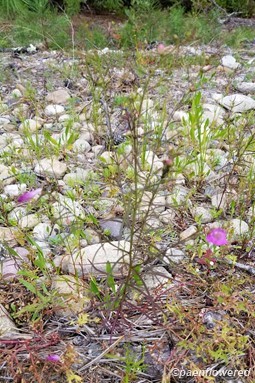
Slenderleaf false foxglove is hemiparasitic, drawing water and nutrients from the roots of nearby grasses and herbaceous plants. It is pollinated by bees, syrphid flies, and butterflies such as the Common Buckeye. The species is named for its slender leaves; tenuifolia means “narrow-leaved.” Leaves are opposite, becoming alternate or sub-alternate toward the flowering portion of the stem; simple, linear, typically 1 to 3 inches long and 1–3 mm wide, with smooth margins and a prominent midrib. In dry conditions, the foliage may turn purplish or reddish.
It blooms from August to October, with each flower lasting only a day. The blossoms are pink to purple, funnel‑shaped, and typically ½ to ⅗ inch long, with five lobes; the lower three are larger than the upper two. Flowers are borne singly in the upper leaf axils on slender, thread‑like pedicels. The interior of the corolla is marked with purple spots and pale yellow to white lines. The stamens and style are pale in color, with the stamens characteristically hairy.
A. tenuifolia reproduces by seed, forming small round capsules after the flowers wither. When the capsules dry, they split open and release numerous tiny seeds, which fall to the ground and may be further scattered by the wind.
Habitat & Range
Frequent in sandy fields, meadows, forest edges and open woods. Prefers full sun to partial shade and moist, well-drained sandy or loamy soils.
Mostly found in the south-east and south-west of the state. See distribution map at BONAP.
Range: Native to eastern and central North America, from southern Canada through the eastern United States and into parts of the Midwest and Southeast.
| EMP: | FAC |
|---|---|
| NCNE: | FACW |
Phenology
Flowers August to early October. Blooming period is 8 to 12 weeks.
Characteristics
Inflorescence flowers solitary in the axils of the upper leaves, giving the appearance of a loose terminal raceme; pedicels 1-2 cm when flower is fully open
Flowers corolla pink to purple, funnel-shaped, 5-lobed; upper lip (two upper lobes) smaller and arching over the stamens, lower lip (3 lower lobes) spreading and larger; ¾″ long
Leaves opposite, becoming sub-alternate or alternate towards top of stem; simple, linear, very narrow; margins entire; pointy, sessile, midrib prominent; 1-3″ long
Stems branching, slender, erect; often red-tinged, mostly glabrous
Fruit dry, smooth, round to slighlty ovoid dehiscent capsule; seeds tiny and numerous
Height 1 to 2 feet
Plant Codes
S-rank: No rank
G-rank: G5 (Secure)
Ecology
Provides late‑season nectar for bees, syrphid flies, and butterflies such as the Common Buckeye.
Leaves and stems are rarely browsed due to their low palatability and narrow form, and the plant is not used for shelter by wildlife.
As a hemiparasite on nearby grasses and forbs, A. tenufolia subtly shapes the surrounding plant community and thrives in open, dry habitats where light reaches the ground.
Agalinis tenuifolia slenderleaf false foxglove




Comments
Have you spotted this plant in your area? We'd love to hear about your experience! Share your comments or questions about the plant below. Comments are moderated before posting.