Verbena bracteata
Verbena bracteata prostrate vervain
 Add to MyPlants
View Distribution
Add to MyPlants
View Distribution
Commonly known as bigbract vervain or prostrate vervain, this plant is native to western and central North America and is adventive in Pennsylvania. It grows in open, disturbed habitats such as roadsides, fields, waste places and riverbanks. This species may behave as an annual, biennial, or short‑lived perennial depending on environmental conditions. It is a low, prostrate plant with decumbent stems that spread outward to form circular, mat‑like patches up to 3 feet across. Because the stems trail along the ground rather than growing upright, the plant’s apparent height is only about 2–10 inches.
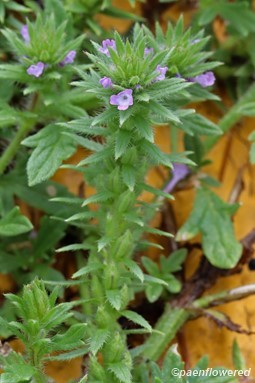
The stems of Verbena bracteata are prostrate to decumbent and measure about 6–18 inches long. They are 4‑angled with a square cross‑section and are thinly to densely covered with long, spreading white hairs. Leaves are opposite and up to 3 inches long and 1 inch wide. Lower leaves are deeply lobed, typically with three primary lobes—the central lobe larger and wedge‑based, tapering to a blunt tip, and the side lobes narrower. These lobes may be further divided into secondary lobes with coarse, blunt teeth along the margins. Upper leaves are smaller, narrower, and usually lack side lobes. Lower leaves have scattered white hairs, while upper leaves are more sparsely hairy.
The flowers bloom from May to October on short terminal spikes typically 1–4 inches long. The tiny blue‑purple flowers are about ⅛ inch across, with a tubular corolla and five rounded, spreading lobes. Each flower is subtended by a prominent leafy bract, giving rise to the common name bigbract vervain. After flowering, the plant produces a dry schizocarp that divides into four hairy nutlets. This species spreads only by reseeding itself.
Bigbract vervain is pollinated by small bees, syrphid flies, and occasional small butterflies. Its leaves serve as food for the caterpillars of the common looper moth and the verbena moth. The plant’s small nutlets are eaten by granivorous birds such as sparrows and juncos, with mourning doves taking them opportunistically.
Habitat & Range
Occasional on ballast, railroad embankments, sidewalks and other disturbed habitats. Prefers full sun and dry to moist, well‑drained soils.
Mostly found in the south-east of the state. See distribution map at BONAP.
Range: Native to central and western North America, extending eastward into the Midwest and parts of the Northeast; adventive in Pennsylvania.
| EMP: | UPL |
|---|---|
| NCNE: | FACU |
Phenology
Flowers May to October, peak bloom in August. Bloom duration is 3 to 6 weeks.
Characteristics
Inflorescence slender, terminal spike; flowers small, bracted, widely spaced
Flowers corolla bluish or purple, with 5 rounded lobes, upper 2 shorter than the lower 3; 4 stames and 1 short style; calyx tubular, hairy, 5‑lobed, lobes pointed and nearly as long as the floral tube; conspicuous bract longer than the flower; ⅛″ across
Leaves opposite, oblong to oblong-lanceolate, pinnately incised or 3-lobed; rough, hairy; margins irregularly toothed; 3″ long, 1″ wide
Stems prostrate to arching, decumbent; hairy, branched; cross-section square
Fruit dry schizocarp; splits into four brown, triangular‑oblong, slightly convex nutlets; 1 seed per nutlet
Height 6 to 18 inches; 2-10 inches (apparent)
Ecology
Supports pollinators and stabilizes soil, contributes to ground‑level biodiversity, and is pollinated by small bees, syrphid flies, and occasional small butterflies.
Its leaves are eaten by the caterpillars of the common looper moth and the verbena moth. The small nutlets provide food for granivorous birds such as sparrows and juncos, with mourning doves taking them opportunistically.
As a disturbance‑adapted species, it helps colonize open soil and maintain plant cover in roadsides, fields, and other early‑successional habitats.
Verbena bracteata prostrate vervain


Comments
Have you spotted this plant in your area? We'd love to hear about your experience! Share your comments or questions about the plant below. Comments are moderated before posting.