Verbena hastata
A wetland native lifting violet spires in late summer
Verbena hastata blue vervain

 Add to MyPlants
View Distribution
Add to MyPlants
View Distribution
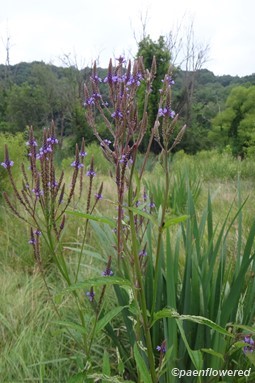
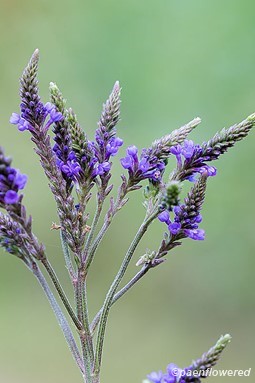
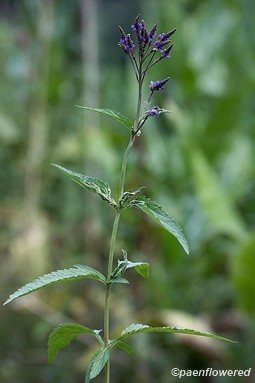
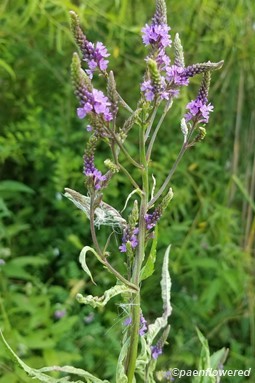
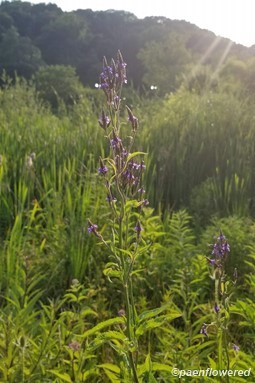
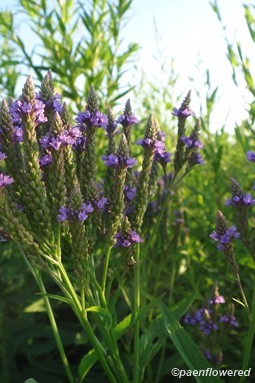
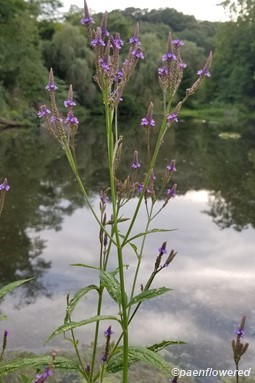
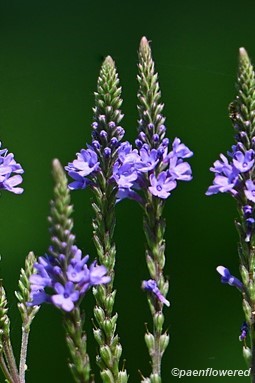
This native perennial wildflower, when in bloom looks a bit like a candelabrum. It forms stiff, vertical, branching pencil-like spikes of small 5-petal purple-blue flowers that bloom a few at a time, advancing towards the pointed tip of the stalk. Individual flowers are 1/8 inch wide and have no scent. Rather than blue, the flowers are usually more violet or deep lavender. The petals fuse to form a flower tube. Bumblebees are among the important pollinators of this species, but a variety of other bees, wasps, butterflies, beetles and flies will visit this plant for nectar or pollen.
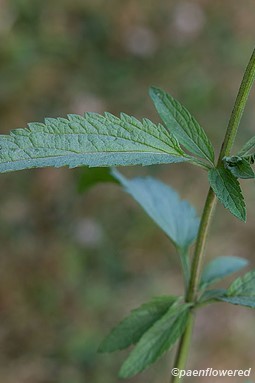
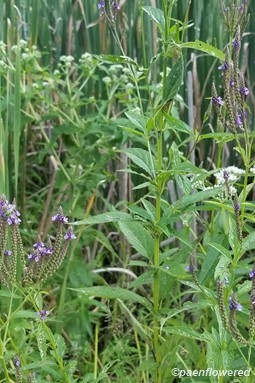
The red or green stem has grooves and is 4-sided. Leaves are 4-6 in. long, opposite, lance-shaped, coarsely toothed and with a rough texture. Lower leaves may have lobes. Most herbivores will not eat it because of the bitter taste. The one exception is the cottontail rabbit, which may eat young foliage to some extent. A variety of songbirds will eat the seeds. It is found in thickets, near streams and ponds and along damp roadsides, The plant may grow 2-7 feet tall and blooms from July to September.
This species is one of the showiest of the vervain species in this area. It is also called swamp vervain or simpler’s joy. There are other species of vervain in the United States with variations in leaf shape and flower size and color. In ancient times European species of vervain were used as a medicinal "cure all". The genus name is Latin for "sacred plant". It is still in use as an herbal medication, but scientists warn that its use may interfere with hormonal therapy or blood pressure medication.
Habitat & Range
Common in wetland margins, moist meadows, marshes, occasionally roadsides. Prefers full sun to light shade and medium to wet soils.
Present in all counties of the state.
Range: Native to most of the United States and to eastern and central Canada.
| EMP: | FACW |
|---|---|
| NCNE: | FACW |
Phenology
Flowers July to September. Bloom duration is 2 to 3 weeks.
Characteristics
Inflorescence branched cluster of many erect, slender spikes terminating stems and upper branches; spikes 2–6″
Flowers corolla bluish-purple, tubular, slightly 2-lipped, with 5 short, slightly spreading lobes; 4 inserted stamens, 1 pistil; calyx short-tubular, with 5 unequal lobes; abt ¼″ long
Leaves simple, opposite, lanceolate to ovate, lower leaves may have 2 shallow basal lobes; coarsely serrate; 3-6″ long, ¾–1½″ wide
Stems stiff, erect, short-hairy, angled; branched in the upper plant; greenish to red
Rhizome short, creeping, slowly expanding; producing clonal offshoots
Fruit dry schizocarp splits into four dark brown, sharply triangular, smooth nutlets; 1 seed per nutlet
Height 2 to 7 feet
Plant Codes
S-rank: S5 (Secure)
G-rank: G5 (Secure)
Medicinal Qualities
Traditionally used for fevers, coughs, cramps, headaches, jaundice, and mild depressive or “low‑spirits” conditions. Topically applied for cuts, ulcers, and skin eruptions.
Still used in modern herbalism, though contemporary sources caution that vervain may interact with hormonal therapies or blood‑pressure medications.
Ecology
Bumblebees are among the primary pollinators of this species, but many other native bees, wasps, butterflies, beetles, and flies also visit the flowers for nectar or pollen.
Most herbivores avoid the bitter foliage, though cottontail rabbits may browse young leaves occasionally. The seeds are eaten by several species of songbirds.
The foliage also serves as a larval food source for the Verbena Moth and the Common Buckeye butterfly.
By providing nectar through midsummer and into early fall, Blue Vervain supports a wide range of pollinators during a seasonal gap, and its presence helps anchor the plant community in wet meadows and streamside habitats.
Verbena hastata blue vervain
.jpg?v=638487129670000000)



Comments
Have you spotted this plant in your area? We'd love to hear about your experience! Share your comments or questions about the plant below. Comments are moderated before posting.